
ShipStation Notion Integration
Sync ShipStation with Notion automatically - orders, shipments, and customers always up to date, no coding needed.
Free to start. No credit card required.
Trusted worldwide
500+ teams stopped copying data manually.
Yours can too.















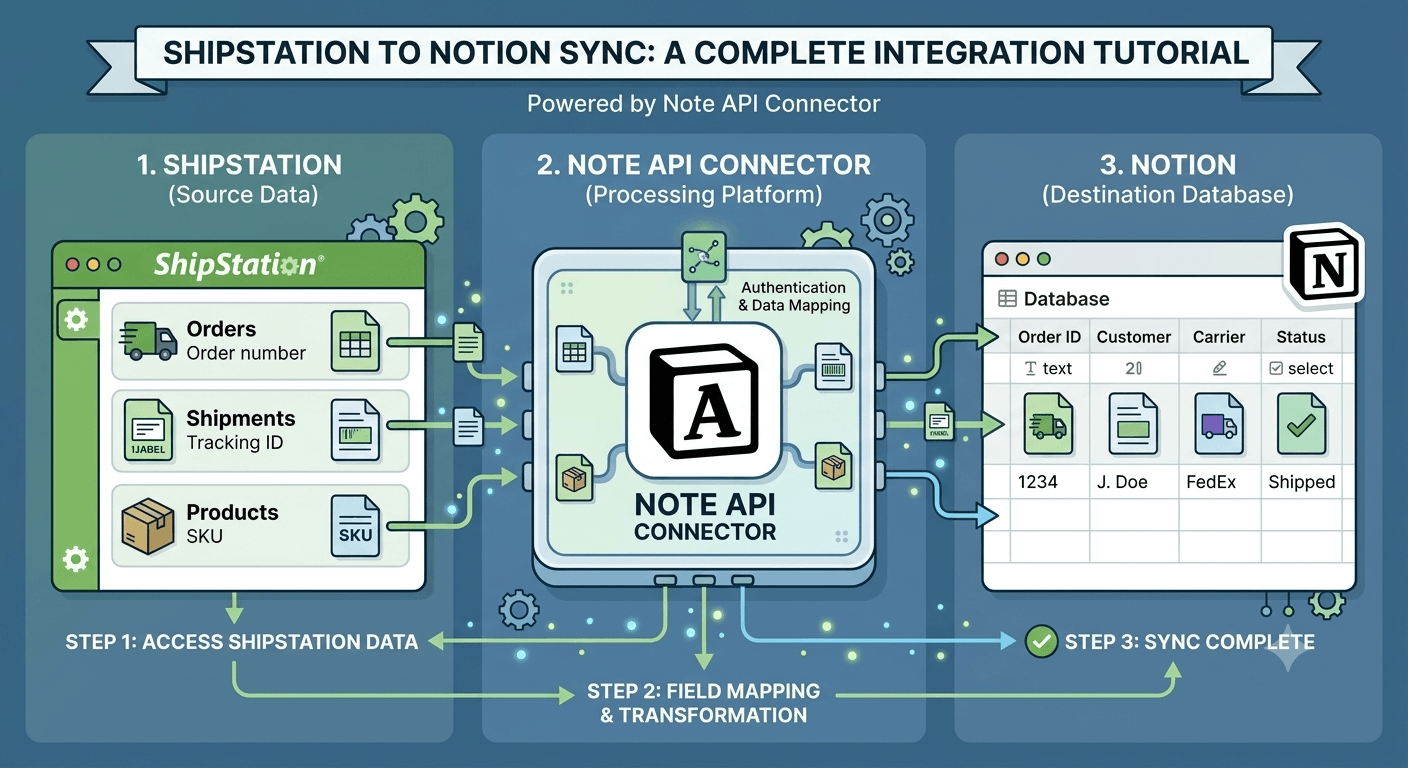
The ShipStation Notion integration lets you pull live order and shipping data directly from your ShipStation account into Notion using Note API Connector. Whether you are building an order tracking dashboard, a customer database, a shipment log, or a product catalog, this integration keeps your Notion databases in sync with ShipStation automatically.
With Note API Connector you can sync ShipStation with Notion on a fully automated schedule (hourly, daily, or at custom intervals) without writing a single line of code. Connect your ShipStation API key and secret, choose a Notion database, map the order, shipment, and customer fields visually, and your ShipStation data flows into Notion on autopilot from that point forward.
How to connect ShipStation to Notion
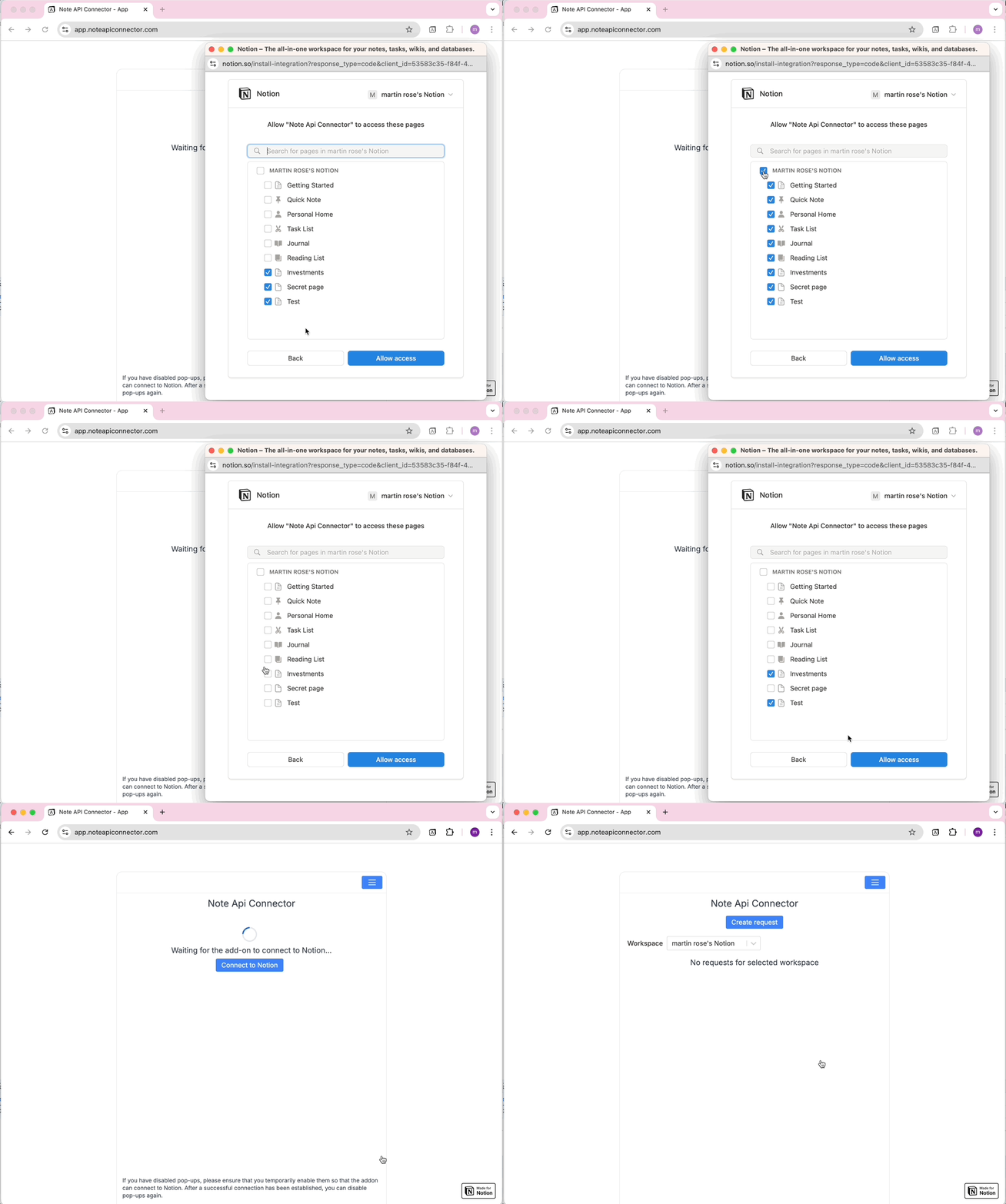
Connect your Notion workspace
Click Connect to Notion, authorize Note API Connector, and select the pages and workspace where your ShipStation data should appear.
Get your ShipStation API key and connect
In ShipStation, go to Settings then Account and open the API Settings page. Click Generate New API Keys if you do not already have one, then copy your API Key and API Secret. In Note API Connector, click Create Request, paste your ShipStation API endpoint URL, open the Authorization tab, select Basic, and enter your API Key as the username and API Secret as the password. Give your request a name, then click Run.
🔑 Basic auth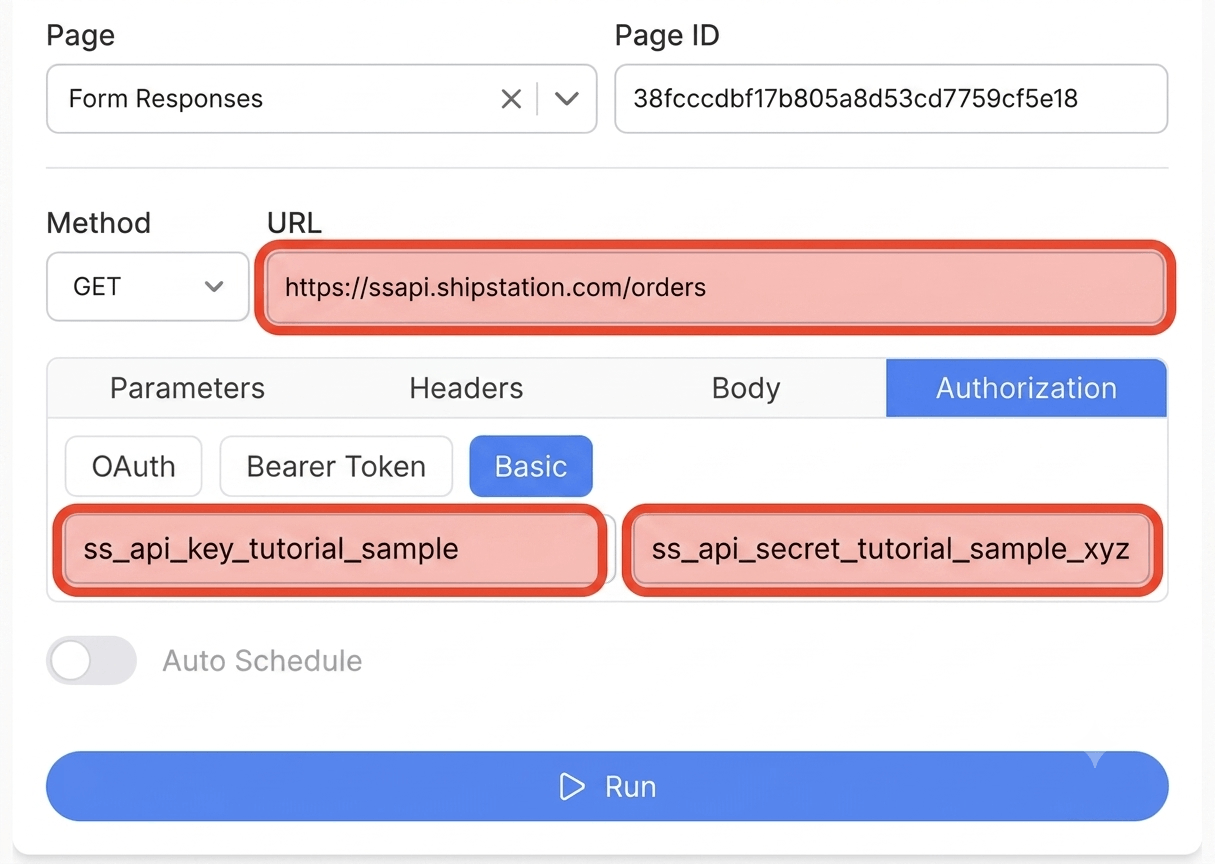
Choose your data and map fields
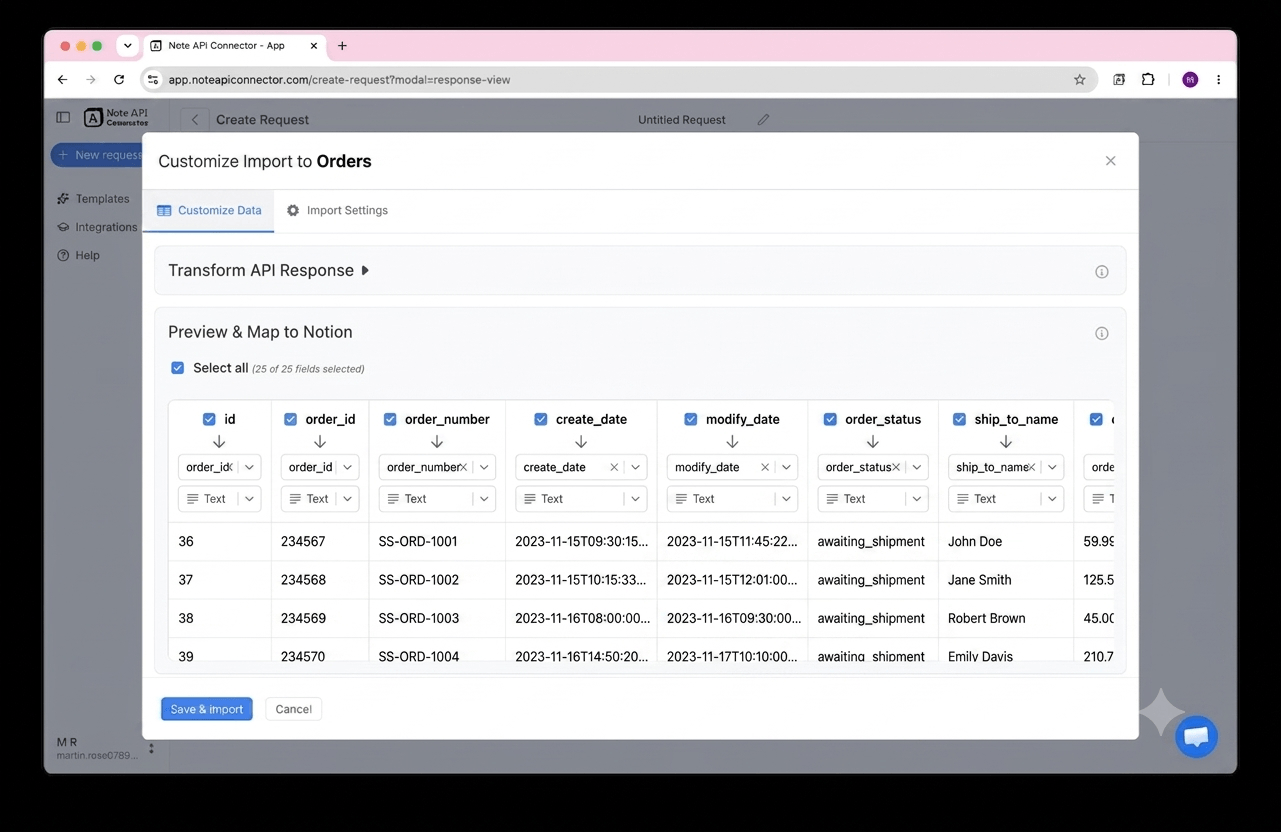
In the Response Field Mapping screen, select which ShipStation fields to include - such as order number, order status, shipping address, or tracking number - and map each one to a Notion property. You can match existing properties, create new ones, or set the field type. Click Save & Import when you're done.
Set your sync schedule and go live
Enable Auto Schedule and choose your refresh interval. Your ShipStation data will sync with Notion automatically from that point forward, with no manual refreshes needed.
⏱ Hourly / Daily / Custom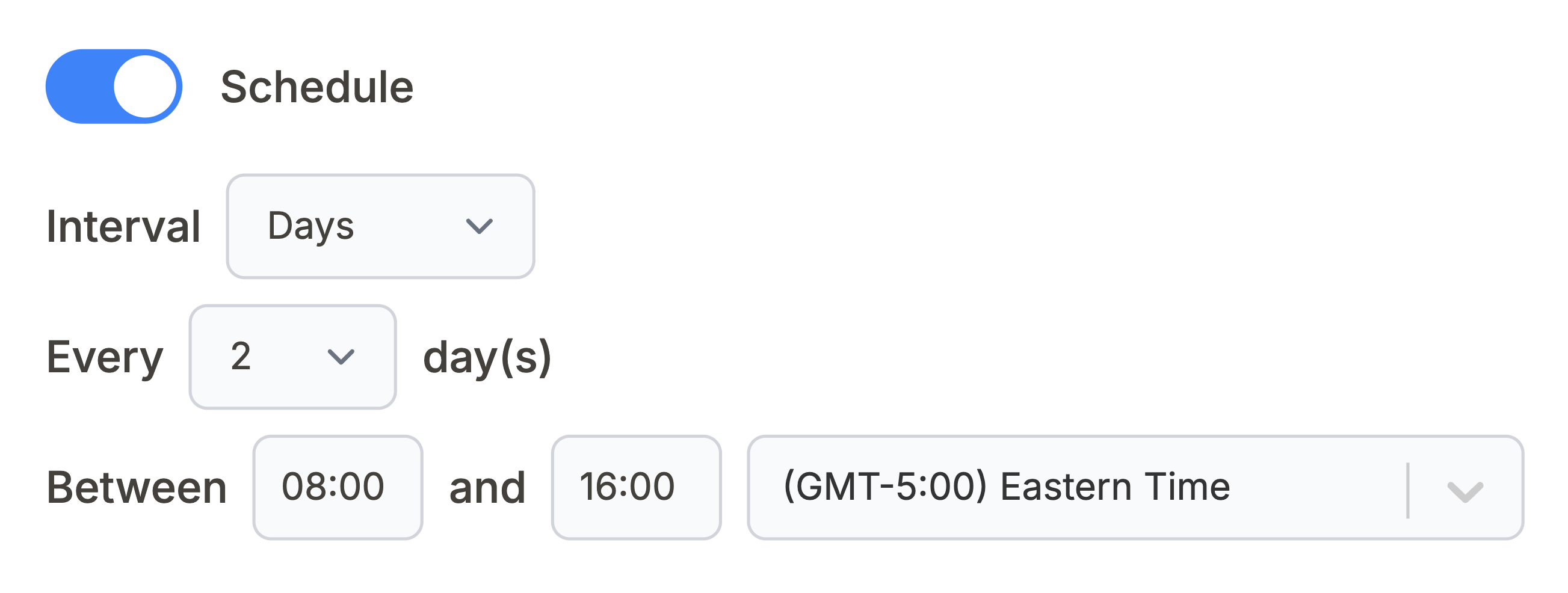
What ShipStation data can you sync with Notion?
Use these ShipStation API endpoints directly in Note API Connector. Each one can be mapped to a separate Notion database.
All orders with status, shipping address, items, and totals. Build a live order tracking board in Notion.
https://ssapi.shipstation.com/orders
All shipments with carrier, service, tracking number, and shipment cost. Build a shipment log in Notion.
https://ssapi.shipstation.com/shipments
Customer records with name, address, and marketplace usernames. Build a searchable customer database directly inside Notion.
https://ssapi.shipstation.com/customers
Your product catalog with SKU, price, weight, and dimensions. Sync your ShipStation product list into Notion.
https://ssapi.shipstation.com/products
All connected selling channel stores, with marketplace name and status. Reference your sales channels when organizing synced order data in Notion.
https://ssapi.shipstation.com/stores
See how it works
Why sync ShipStation with Notion?
Always up to date
Scheduled sync runs automatically. Your Notion database reflects live ShipStation data without any manual work.
No coding required
Point, click, and map fields. Connect ShipStation to Notion in minutes without any programming knowledge.
Custom schedule
Choose hourly, daily, or custom intervals. You control exactly when Notion pulls fresh data from ShipStation.
Conclusion
With Note API Connector, setting up a complete ShipStation Notion integration takes minutes, not days. Your order, shipment, and customer data sync automatically into Notion on your chosen schedule, with no code and no manual copy and paste.
Whether you are building a live order tracking dashboard, a customer database for your support team, or a shipment log for your fulfillment operation, connecting ShipStation to Notion gives you the flexibility of Notion's interface with the accuracy of your fulfillment data.
Frequently Asked Questions
Yes. ShipStation provides a REST API that exposes orders, shipments, customers, products, and connected stores. Note API Connector connects to this API using Basic authentication with your API Key and Secret to pull your ShipStation data into Notion on a scheduled basis.
In ShipStation, go to Settings, then Account, and open API Settings to generate your API Key and API Secret. In Note API Connector, connect your Notion workspace, click Create Request, paste a ShipStation API endpoint URL, open the Authorization tab, select Basic, and enter your API Key as the username and API Secret as the password.
Yes. Enable Auto Schedule in Note API Connector and choose your refresh interval: hourly, daily, or custom. Your ShipStation data will sync into Notion automatically on that schedule with no manual action required.
ShipStation's newer v2 API is built for creating shipments, labels, and rates, but it does not include a general endpoint for listing all orders the way v1 does. Since most Notion syncs are built around order and customer records, this guide uses the v1 API, which ShipStation still fully supports for existing integrations.
You can sync orders, shipments, customers, products, and connected stores. Each ShipStation API endpoint can be mapped to a separate Notion database, so you can build a complete fulfillment overview inside Notion.
No. Note API Connector is a no-code tool. You paste your ShipStation API endpoint URL, add your API Key and Secret under Basic authentication, select your Notion database, and map fields visually. No programming knowledge is needed.
Yes. Note API Connector uses read-only access via your ShipStation API credentials. Your credentials are never stored in plain text, and Note API Connector never writes or modifies any data in your ShipStation account.
ShipStation limits each API Key and Secret pair to 40 requests per minute. Note API Connector's scheduled sync stays well within this limit for typical use, so you do not need to worry about hitting the rate limit during normal automated syncs.