DocuSign Notion Integration
Sync DocuSign with Notion automatically - envelopes, templates, users, and folders always up to date, no coding needed.
Free to start. No credit card required.
Trusted worldwide
500+ teams stopped copying data manually.
Yours can too.














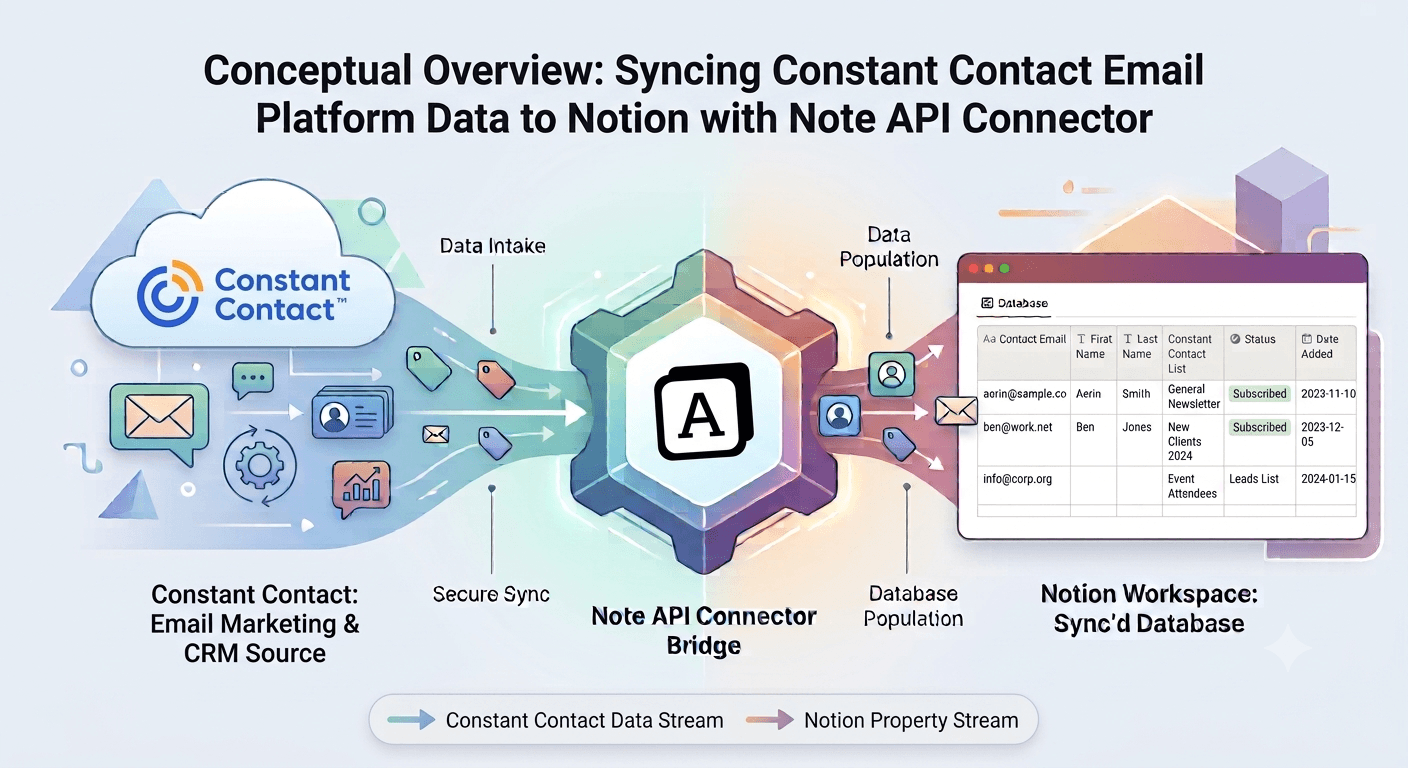
The DocuSign Notion integration lets you pull live e-signature data directly from your DocuSign account into Notion using Note API Connector. Whether you are tracking envelope status, archiving completed agreements, monitoring which templates are used most, or keeping a record of users and folders, this integration keeps your Notion databases in sync with DocuSign automatically.
With Note API Connector you can sync DocuSign with Notion on a fully automated schedule (hourly, daily, or at custom intervals) without writing a single line of code. Connect DocuSign through a secure OAuth connection, choose a Notion database, map the fields visually, and your data flows into Notion on autopilot from that point forward.
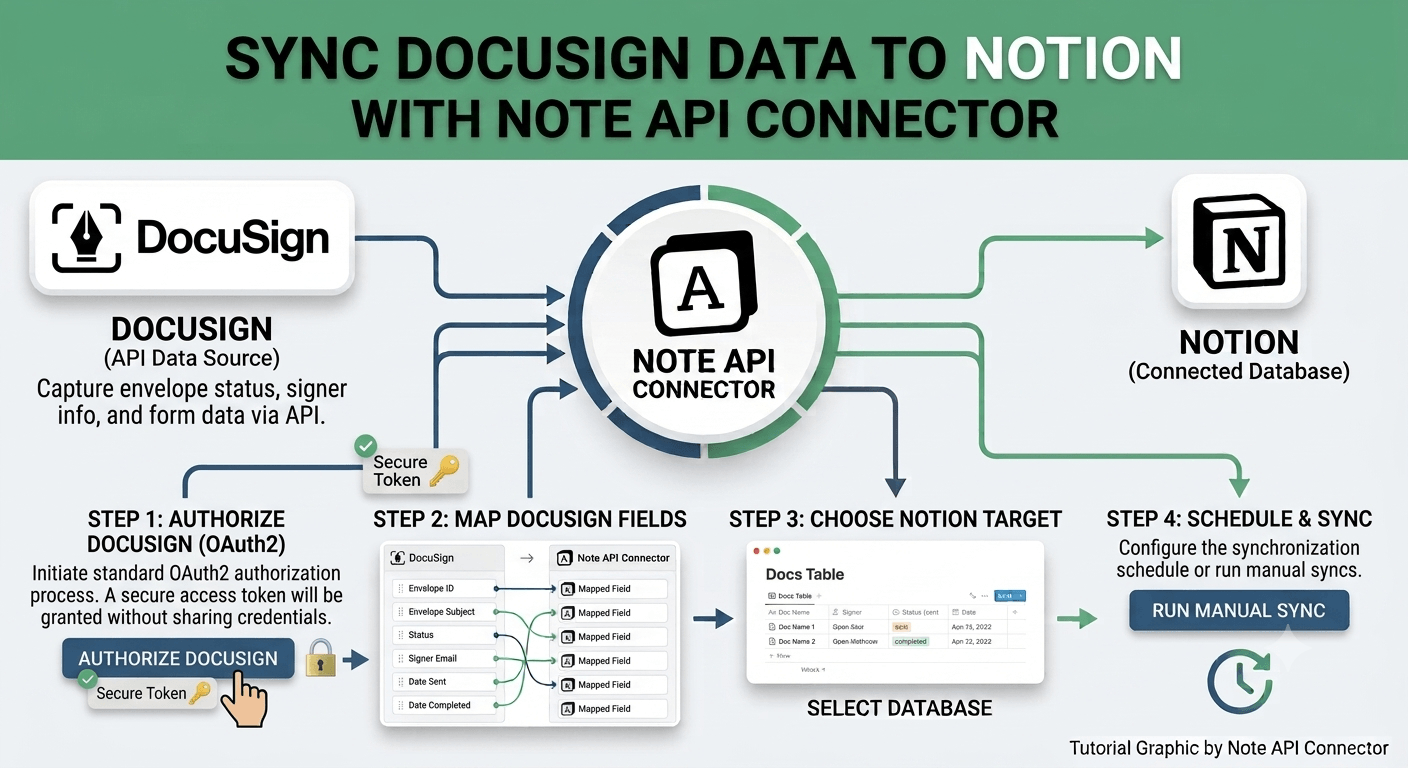
How to connect DocuSign to Notion
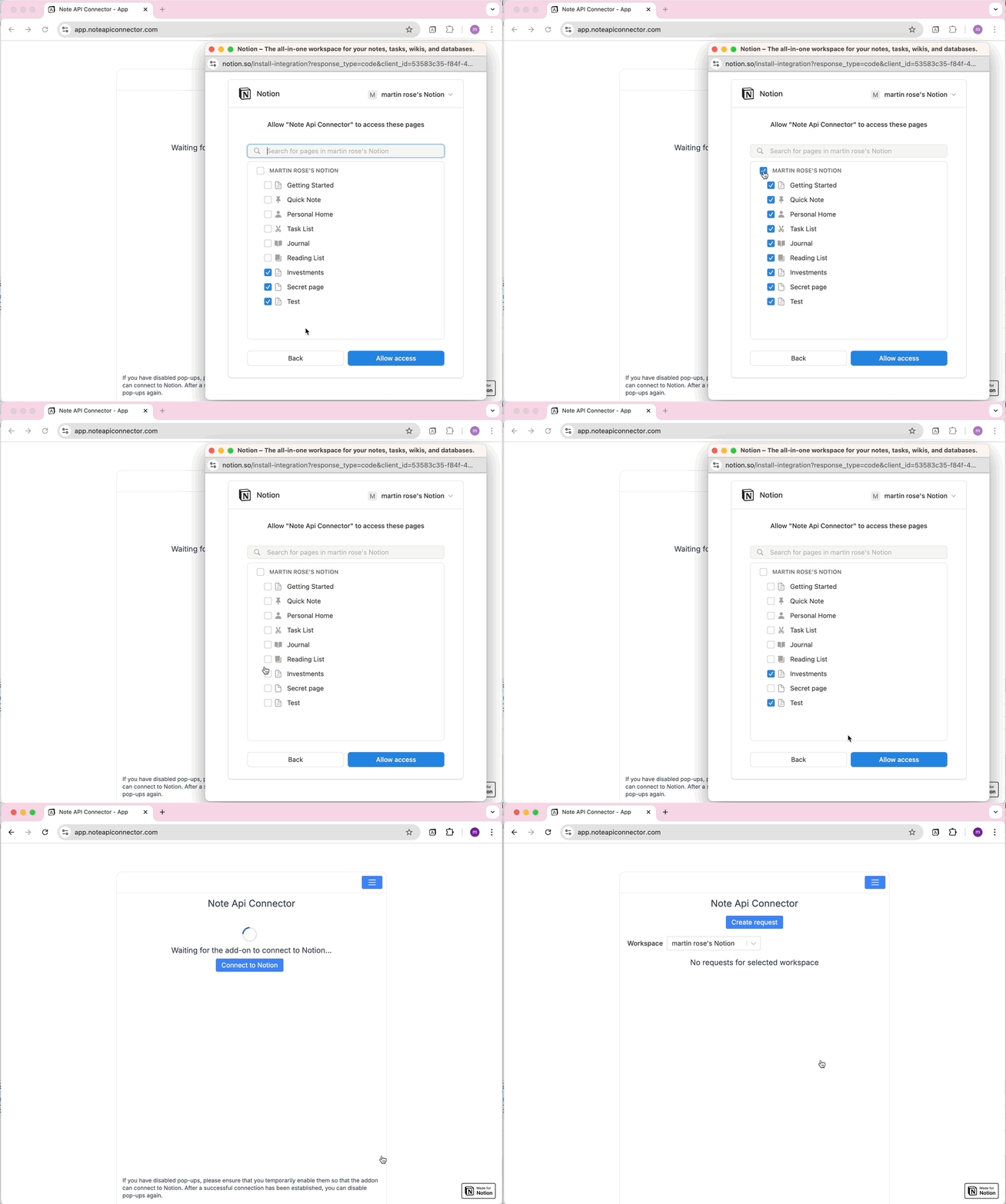
Connect your Notion workspace
Click Connect to Notion, authorize Note API Connector, and select the pages and workspace where your DocuSign data should appear.
Register an app in DocuSign Apps and Keys
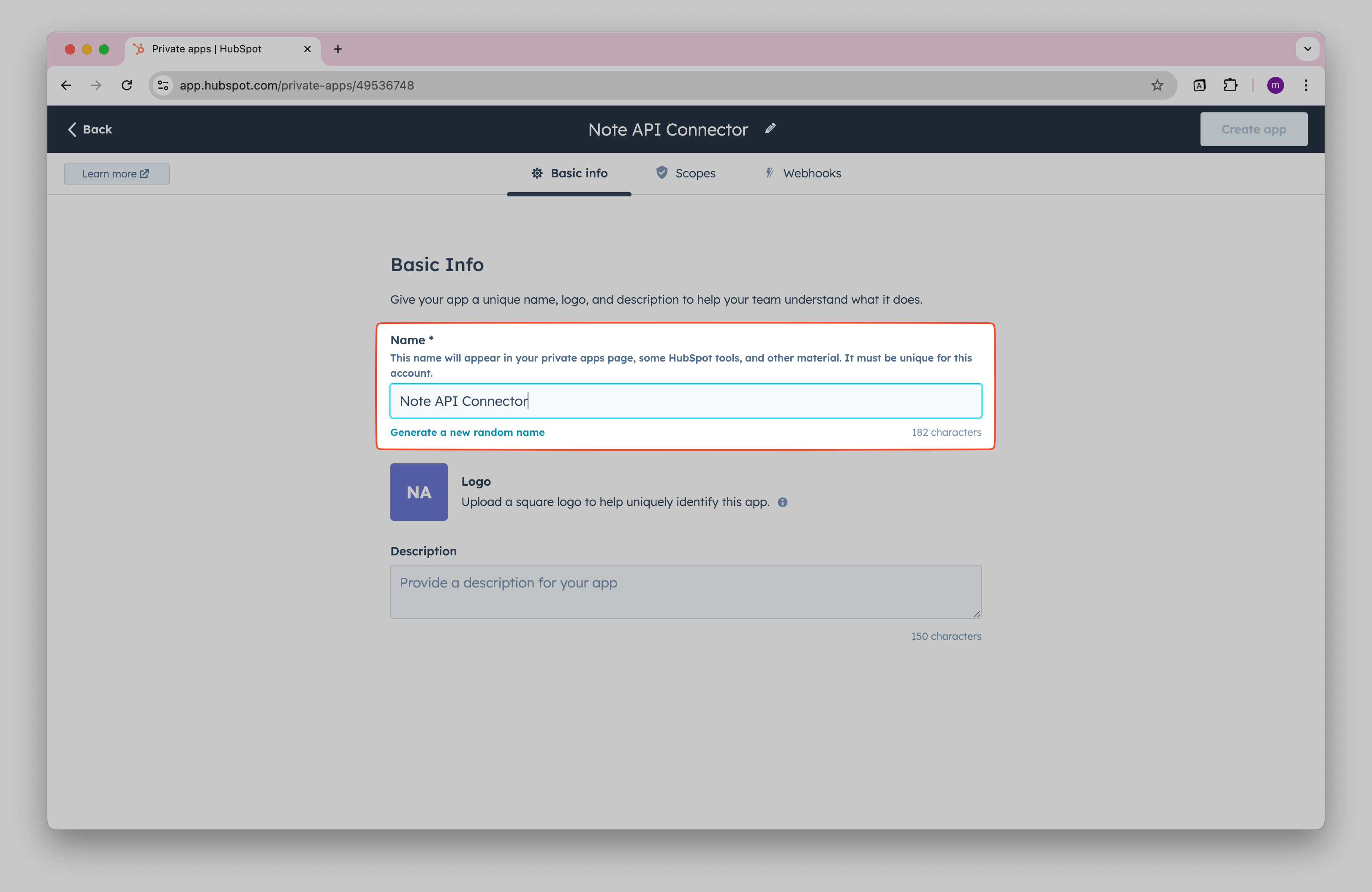
DocuSign only supports OAuth 2, so there is no simple API key to copy and paste. Sign in to your DocuSign account, click your profile icon, open My Apps and Keys, and add a new app as a Confidential integration with a Secret Key. Set the redirect URI to https://api.noteapiconnector.com/oauth/callback. Copy your Integration Key (Client ID) and Secret Key. New apps start in DocuSign's free developer sandbox - to sync a real production account you will need to complete DocuSign's Go-Live process first, which links your Integration Key to a paid production account.

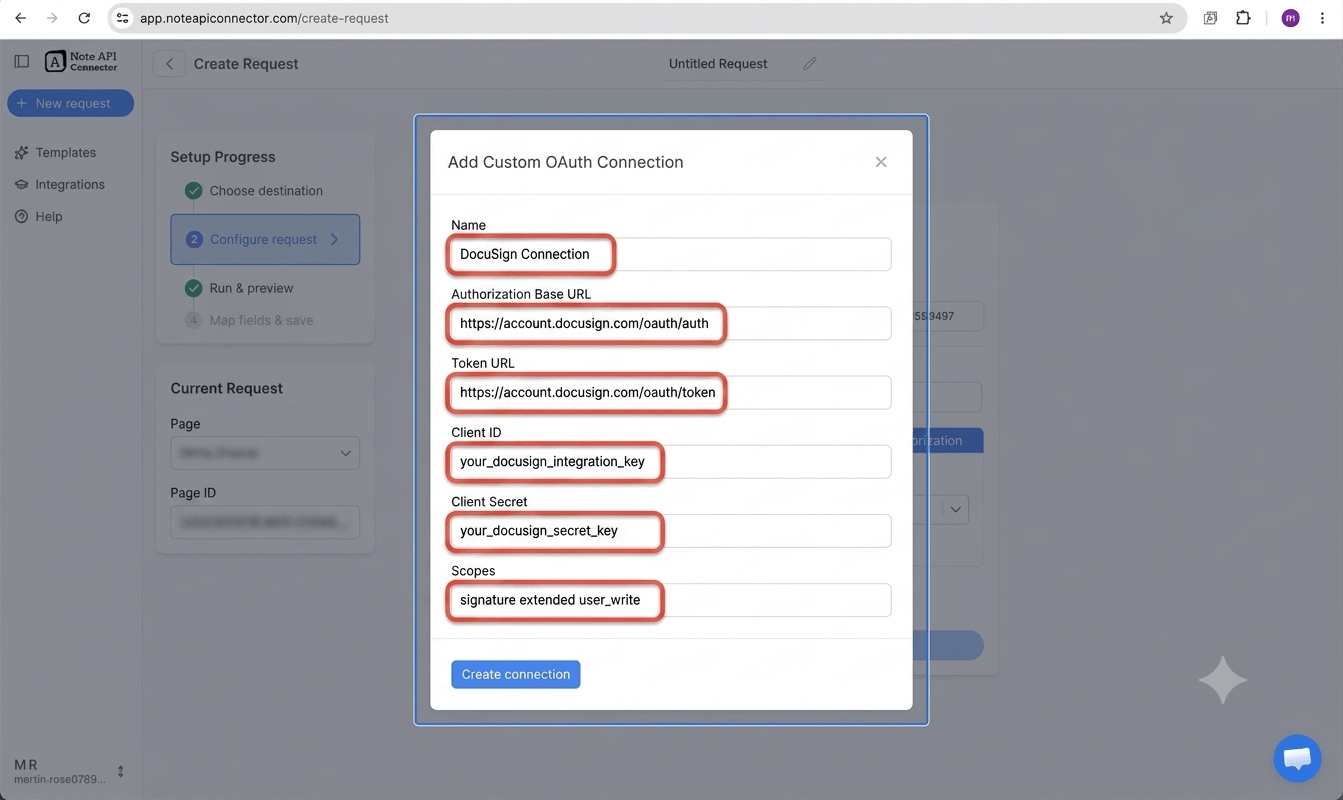
Create a custom OAuth connection and find your base URI
In Note API Connector, click Create Request, open the Authorization tab, click OAuth, then New. Enter Authorization Base URL https://account.docusign.com/oauth/auth, Token URL https://account.docusign.com/oauth/token (use account-d.docusign.com instead for the free developer sandbox), your Integration Key, Secret Key, and scope signature. Click Create connection and approve access. DocuSign accounts each have a unique base URI, so run one request to https://account.docusign.com/oauth/userinfo using the same OAuth connection - the response returns your account_id and base_uri (for example https://na3.docusign.net), which you will use in every data request below.
Choose your data, map fields, and go live
Paste an endpoint URL using your own base URI and account ID, for example https://na3.docusign.net/restapi/v2.1/accounts/YOUR_ACCOUNT_ID/envelopes?from_date=2026-01-01T00:00:00Z, and run it. In the Response Field Mapping screen, select which DocuSign fields to include - such as envelope status, subject, sent date, or signer name - and map each one to a Notion property. Click Save & Import, then enable Auto Schedule so your data keeps syncing automatically.
What DocuSign data can you sync with Notion?
Use these DocuSign API endpoints directly in Note API Connector. Each one can be mapped to a separate Notion database.
Envelopes (agreements sent for signature) with status, subject, and sent date. Requires a from_date, envelope_ids, or folder_ids filter. Build a live agreement tracker or signature status dashboard inside Notion.
https://{YOUR_BASE_URI}/restapi/v2.1/accounts/{YOUR_ACCOUNT_ID}/envelopes?from_date=2026-01-01T00:00:00Z
All reusable envelope templates with name, description, and last modified date. Reference your template library when reviewing which agreements are in use inside Notion.
https://{YOUR_BASE_URI}/restapi/v2.1/accounts/{YOUR_ACCOUNT_ID}/templates
All users on your DocuSign account with name, email, and status. Build a team directory or cross-reference senders when reviewing envelope activity inside Notion.
https://{YOUR_BASE_URI}/restapi/v2.1/accounts/{YOUR_ACCOUNT_ID}/users
All folders used to organize envelopes and templates, with folder name and item count. Mirror your DocuSign folder structure inside Notion.
https://{YOUR_BASE_URI}/restapi/v2.1/accounts/{YOUR_ACCOUNT_ID}/folders
Recipients and signers for a specific envelope, with name, email, and signing status. Replace ENVELOPE_ID with an ID returned by the Envelopes query above to track who has signed inside Notion.
https://{YOUR_BASE_URI}/restapi/v2.1/accounts/{YOUR_ACCOUNT_ID}/envelopes/ENVELOPE_ID/recipients
See how it works
Why sync DocuSign with Notion?
Always up to date
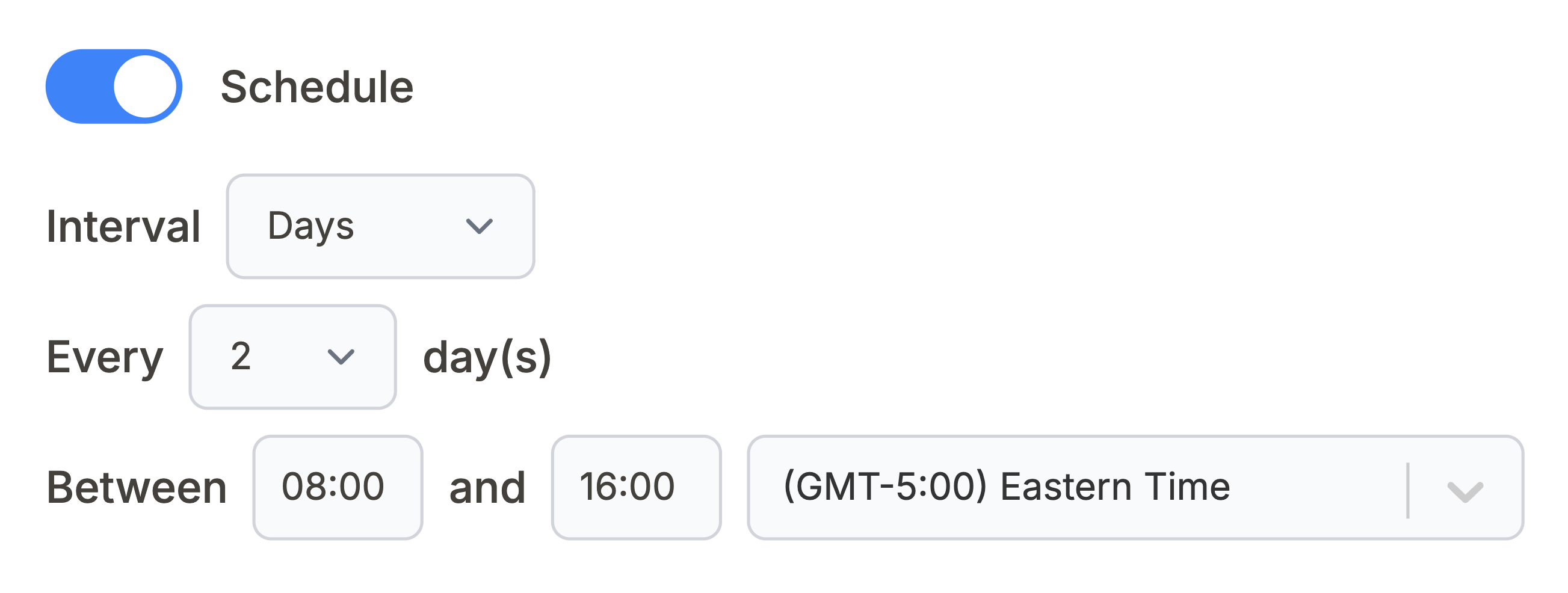
Scheduled sync runs automatically. Your Notion database reflects live DocuSign data without any manual work.
No coding required
Point, click, and map fields. Connect DocuSign to Notion in minutes without any programming knowledge.
Custom schedule
Choose hourly, daily, or custom intervals. You control exactly when Notion pulls fresh data from DocuSign.
Conclusion
With Note API Connector, setting up a complete DocuSign Notion integration takes only a few extra minutes for the one-time OAuth and base URI setup. After that, your envelopes, templates, and user data sync automatically into Notion on your chosen schedule, with no manual copy-paste.
Whether you are building a live contract status dashboard, tracking which agreements are still awaiting signature, archiving completed envelopes for compliance, or giving your team a read-only view of signature activity in Notion, connecting DocuSign to Notion gives you the flexibility of Notion's interface with the real-time accuracy of DocuSign's data.
Frequently Asked Questions
Yes. DocuSign provides the eSignature REST API (v2.1) that exposes envelopes, templates, users, folders, and recipients. Note API Connector connects to this API using a secure OAuth 2 connection to pull your DocuSign data into Notion on a scheduled basis.
Yes. DocuSign only supports OAuth 2 authentication, with no personal API key alternative. You need to register a free app in DocuSign under My Apps and Keys and create a custom OAuth connection in Note API Connector using your Integration Key and Secret Key.
New DocuSign Integration Keys start in a free developer sandbox (account-d.docusign.com) for testing. To sync data from your real, paid production DocuSign account, you must complete the Go-Live process, which links your Integration Key to your production account. As of 2025 this process is largely automated and can complete instantly for most simple integrations.
Every DocuSign account is hosted on a specific data center (such as na3.docusign.net or eu.docusign.net), so there is no single fixed API base URL. After creating your OAuth connection, you call https://account.docusign.com/oauth/userinfo once to retrieve your account_id and base_uri, then use those values to build every other DocuSign API request.
Register an app under My Apps and Keys in DocuSign, set the redirect URI to https://api.noteapiconnector.com/oauth/callback, and copy your Integration Key and Secret Key. In Note API Connector, open Create Request, go to the Authorization tab, click OAuth then New, and enter the DocuSign authorization URL, token URL, your credentials, and the signature scope. After approving access, call the userinfo endpoint to get your account_id and base_uri, then paste a data endpoint such as the Envelopes URL, select your Notion database, and map the fields visually.
Yes. Enable Auto Schedule in Note API Connector and choose your refresh interval: hourly, daily, or custom. Once your OAuth connection and base URI are set up, your DocuSign data will sync with Notion automatically on that schedule with no manual action required.
You can sync envelopes, templates, users, folders, and envelope recipients. Each DocuSign endpoint can be mapped to a separate Notion database, so you can build a full contract status dashboard and signature tracker in one Notion workspace.
Yes. Note API Connector connects to DocuSign using OAuth 2, the same secure standard used by major providers like Google. Your Secret Key and access tokens are stored securely, and Note API Connector never writes or modifies any data in your DocuSign account.